
The Rise of AI in CCTV: It’s Not Just for Recording Anymore
February 18, 2026 |
By Junaid Farooq
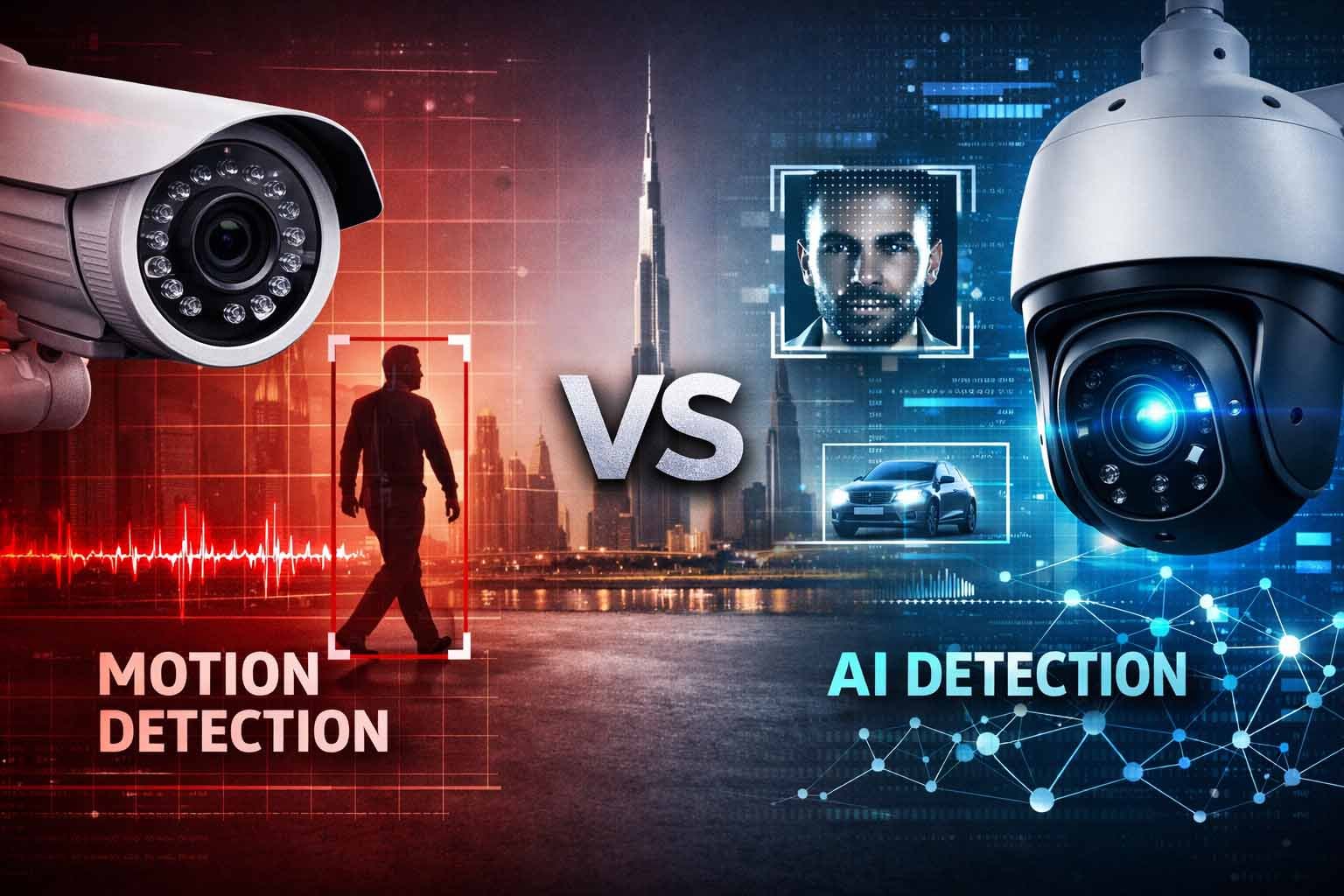
Surveillance technology in Dubai, the UAE and across the GCC is undergoing a profound transformation. What was once a network of passive cameras simply recording events has evolved into intelligent systems capable of real‑time threat detection, behaviour analysis, and even predictive security insights. Traditional CCTV motion detectors are being outpaced by AI‑driven detection systems that reduce false alarms, improve response, and deliver valuable operational intelligence not just video footage.
Understanding Traditional CCTV and Motion Detection
Traditional CCTV systems use fixed cameras that continuously record video, capture motion based on pixel changes, and require human monitoring to spot anything of interest. Motion detection is the oldest method of triggering alerts if the camera feed detects change in pixels, it flags movement and starts recording or alerts security teams.
Limitations of Motion Detection
- High False Alarm Rates: Motion triggers from shadows, weather effects, leaves, animals, and lighting changes are common.
- Reactive Approach: Alerts are generated after motion occurs no pattern recognition, no context.
- Requires Human Review: Most footage still must be watched by security staff.
According to industry insights, traditional motion detection often creates a deluge of notifications that overload operators, leading to missed events and “alarm fatigue.” This has real operational costs for facilities in Dubai: increased personnel hours, slower incident response, and dependence on humans to interpret activity.
| Feature | Traditional Motion Detection | AI Detection |
| Detects Pixel Change | Yes | Yes |
| Recognizes Humans or Vehicles | No | Yes (highly accurate) |
| Behaviour Analysis | No | Yes |
| False Positive Filter | No | Yes reduces dramatically |
| Real‑time Automated Alerts | Limited | Advanced |
| Predictive Detection | No | Emerging |
What is AI Detection in CCTV?
AI detection leverages computer vision, machine learning and deep learning to interpret video feeds. Instead of reacting to pixel movement, the system understands what’s happening classifying objects (people vs vehicles), extracting behaviours, and identifying anomalies like loitering, crowd build‑ups, perimeter breaches or unauthorized access.
Modern AI CCTV systems operate either at the edge (on‑device) or in the cloud, analysing data in real time to notify security teams as events unfoldwithout waiting for human review. This shift transforms cameras from passive recording tools to active security assets.
Core AI Detection Capabilities
- Human/Vehicle Recognition — differentiates between objects and ignores irrelevant motion.
- Loitering & Behaviour Analysis — flags unusual activity over time.
- Facial Recognition & LPR (License Plate Recognition) — identifies individuals and vehicles.
- Heatmaps & Analytics — provides business intelligence like foot traffic or crowd density.
- Predictive Insights — warns of likely incidents based on patterns.
Security operators in Dubai increasingly adopt AI CCTV because it reduces false positives by up to 85‑95% compared to traditional motion alerts a figure confirmed by security technology studies and case accounts.
The UAE Context: Why AI CCTV Matters
Dubai’s rapid urbanisation and emphasis on safety make effective surveillance essential. Government initiatives like Falcon Eye and smart city frameworks integrate AI at scale for national security, public safety, and infrastructure protection.
Demand Drivers in UAE
- Growing need for proactive surveillance in public spaces, malls, real estate developments and transport hubs.
- Integration with IoT sensors and access control to create unified security systems.
- Tourism, commercial growth and major events requiring predictive threat detection.
AI CCTV systems help organisations detect threats before they escalate, giving security teams time‑critical alerts and reducing dependency on manual monitoring. In fast‑moving urban environments like Dubai, this is a decisive advantage.
Real‑World Benefits of AI Detection vs Motion Detection
1. Accuracy and Reduced False Alarms
Traditional motion detectors cannot distinguish between benign and suspicious motion. In contrast, AI discriminates high‑risk events (people trespassing) from innocuous ones (fluttering plastic bags). Studies show AI systems cut false alarms drastically enhancing operational efficiency.
2. Enhanced Situational Awareness
AI provides context who is moving, what they are doing, when and where. Motion only tells that movement occurred. This means faster, more reliable threat responses.
3. Intelligent Alerts & Prioritization
AI systems prioritise critical alerts (breach, loitering) and filter out noise. Security officers focus on real threats, not dozens of inconsequential notifications.
4. Analytics Beyond Security
Cameras with AI can produce people counting, heatmaps, queue analysis data valuable not just for security but for business intelligence (e.g., retail or facility management).
Statistical Snapshot: AI Detection Performance
| Metric | Traditional Motion | AI Detection |
| False Positive Rate | High (50‑80%) | Low (≤15%) |
| Accuracy of Human Detection | Low | High (95‑99%) |
| Real‑Time Alerting | Limited | Advanced |
| Behaviour Recognition | None | Yes |
| Predictive Potential | None | Emergent |
Buying Guide: Choosing What’s Best for Your Security
For organisations evaluating CCTV upgrades in Dubai:
When Motion Detection May Be Enough
- Small residences with low risk
- Low activity environments with limited intrusion risk
When AI Detection Is Worth It
- Commercial complexes, malls, hotels
- High‑risk facilities (banks, airports, logistics)
- Public spaces needing proactive monitoring
- Integrations with access control, IoT devices
Considerations Before Purchase
- Resolution: Minimum 1080p recommended for reliable AI analysis.
- Edge vs Cloud: Edge reduces latency; cloud enables scalable analytics.
- Integration Capabilities: Seamless API with VMS, alarms, access controls.
- Privacy and Data Regulations: Ensure compliance with UAE privacy laws.
Conclusion: AI Detection Is the Future of CCTV Surveillance
Traditional motion detection served its purpose for decades. But in today’s smart, highly dynamic security landscape especially in Dubai and the wider UAE AI detection transforms CCTV from a passive recorder into an intelligent protector. It reduces false alarms, enhances real‑time insights, supports proactive intervention, and adds business intelligence too.
Motion detection is reactionary; AI detection is proactive and predictive. Organisations seeking effective security whether for residential communities, corporate facilities, retail zones, or government infrastructure should prioritise AI‑enabled CCTV systems for smarter, safer surveillance.
As we move toward fully interconnected IoT and AI ecosystems, surveillance evolves from watching to understanding and that’s the defining difference between old‑school CCTV and next‑gen security intelligence.

Junaid Farooq
A technology specialist with a focus on IT infrastructure and security solutions. Shares expert advice on topics like access control, CCTV, and smart solutions to help businesses across the UAE build smarter, more secure systems.