
Touchless Entry Systems: Why Your Office Needs Them Now
March 27, 2026 |
By Junaid Farooq
Summary:
Touchless entry systems remove physical contact from office access. They use facial recognition, mobile credentials, and QR codes to keep workplaces safe and hygienic after the pandemic.
Think about how many people touch your office door handle every single day. Now think about the keypad at the entrance. The fingerprint scanner. The shared swipe card reader. Each one of these surfaces collects bacteria, viruses, and grime from every person who uses it.
Before 2020, nobody thought twice about pressing buttons or scanning fingers to get into the office. COVID-19 changed that overnight. The World Health Organization confirmed that viruses could survive on shared surfaces for hours. Suddenly, every common touchpoint became a health concern.
Restrictions have eased. Life has moved forward. But the awareness has not disappeared. Employees still hesitate before pressing shared buttons. Clients notice when a reception area feels outdated. Building managers know that old access methods carry risks they can no longer ignore.
This is where touchless entry systems become essential. They remove physical contact from the access process entirely. No buttons. No shared scanners. No key cards passing between hands. Instead, these systems use smart technology to verify identity and grant entry within seconds.
For offices across Dubai, Abu Dhabi, and the wider UAE, adopting contactless access control is a decision that protects people, strengthens security, and signals that your business operates at a modern standard.
What Exactly Are Touchless Entry Systems?
A touchless entry system is an access control solution that allows authorized individuals to enter a building, floor, or room without physically touching any device. Traditional office entry methods require direct contact. You press a PIN. You swipe a card. You place your finger on a scanner. Every interaction involves a shared surface.
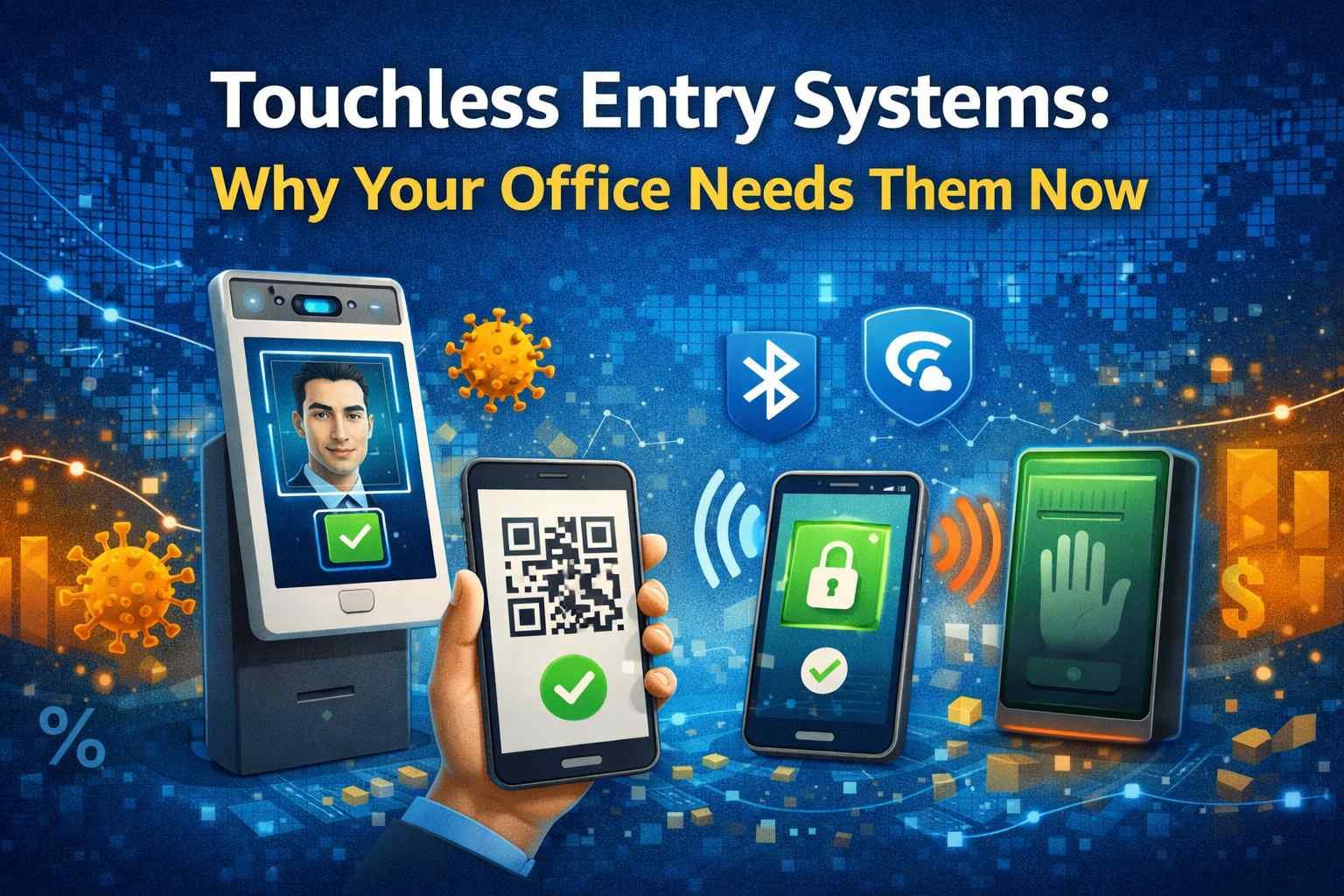
Touchless systems replace all of that with contact-free technology. The most common types include the following.
Facial Recognition Access Control
Cameras placed at entry points scan a person’s face and match it against a stored database. If the face matches an authorized profile, the door unlocks. The entire process takes less than two seconds. No contact required.
Mobile Credential Access
Employees use a smartphone app to unlock doors. The phone communicates with the door reader through Bluetooth Low Energy (BLE) or Near Field Communication (NFC). Some systems unlock automatically when the phone comes within range. Others require a single tap on the screen.
QR Code Entry
The system generates a unique QR code sent to a person’s phone via email or app. At the door, they hold the screen up to a reader. The code is verified instantly and access is granted. This method works exceptionally well for visitor management.
Infrared Motion Sensors
These sensors detect hand movement near a reader without any physical contact. A simple wave near the sensor triggers the door to open. This works best for internal doors, restrooms, and common areas within an office.
Voice Recognition Systems
Some advanced setups use voice authentication. The person speaks a passphrase or simply says their name. The system matches the vocal pattern to stored data and grants or denies access accordingly.
Most modern offices combine two or three of these technologies. Facial recognition might guard the main entrance. Mobile credentials might control floor access. QR codes might handle visitor entry. Layering creates both convenience and stronger security.
How the Pandemic Permanently Changed Office Access
Before COVID-19, fingerprint scanners were considered the gold standard for office security. They were affordable, accurate, and widely available. Keypads were everywhere. Shared swipe cards were handed out without a second thought.
The pandemic exposed the flaw in all of these systems. Every single one depends on people touching a shared surface. When the WHO issued warnings about surface transmission, companies scrambled. Fingerprint scanners were disabled. Keypads were wrapped in plastic. Temporary badges replaced swipe cards.
These were band-aid solutions. They introduced new problems. Disabled scanners left doors unsecured. Plastic-covered keypads still required touching. Temporary badges were easy to lose and impossible to track properly.
The real answer was always permanent contactless infrastructure. Companies that adopted touchless entry systems early gained immediate advantages. They kept employees safer. They maintained security standards. They avoided the chaos of temporary fixes.
Now, years after peak restrictions, the shift in employee expectations is permanent. Studies from 2023 and 2024 confirm that a significant majority of workers prefer offices equipped with contactless technology. They view it as a basic standard, not a premium feature. Offices that still rely on outdated access systems risk appearing behind the times to both employees and clients.
7 Reasons Your Office Needs Touchless Entry Systems Now
1. Remove Germ-Spreading Contact Points
Every shared surface in your office is a potential carrier. Keypads, handles, fingerprint scanners, and card readers collect germs from every user throughout the day. Cleaning schedules help but cannot eliminate the risk entirely.
Touchless entry systems solve this at the source. When nobody touches anything, there is no surface to contaminate. Facial recognition and mobile access keep hands free and entry points clean. This directly reduces illness transmission and the sick days that follow.
2. Upgrade Security Beyond Traditional Methods
PIN codes get shared between colleagues. Key cards get lost in parking lots. Fingerprints can be lifted and replicated with the right tools. Traditional access methods have well-documented vulnerabilities.
Touchless alternatives are significantly harder to compromise. Facial recognition maps unique biometric data points that cannot be easily duplicated. Mobile credentials are encrypted and tied to a specific device. QR codes expire after a set time or single use. Each method adds a layer of protection that older systems simply cannot match.
3. Eliminate Entry Bottlenecks
Peak morning hours create frustrating queues at office entrances. Employees wait to swipe cards, enter codes, or scan fingers one at a time. This wastes productive minutes every single day.
Touchless systems process entry almost instantly. A facial recognition camera identifies an employee and unlocks the door in under two seconds, even while they are still walking toward it. Mobile credentials work within proximity, opening the door before the person even reaches for a handle. The result is a smooth, uninterrupted flow of people through the building.
4. Make a Strong First Impression
When a potential client or business partner visits your office, the entry experience sets the tone. A modern, sleek touchless access point communicates professionalism, investment in technology, and attention to safety.
Compare that with a sticky keypad or a worn-out card reader. In competitive markets like Dubai and Abu Dhabi, where business image carries real weight, this difference matters more than many companies realize.
5. Simplify How You Manage Visitors
Paper visitor logs are unreliable. Handwritten names are often illegible. Temporary badge systems require staff at the front desk to handle distribution and collection manually. The entire process is slow, error-prone, and difficult to audit.
Touchless entry systems integrate with digital visitor management platforms. Before a meeting, your guest receives a unique QR code via email. They arrive, scan the code, and walk in. The system logs their entry time, notifies their host, and restricts their access to approved areas only. When they leave, the system records their departure. Every visit is documented automatically for compliance and security reviews.
6. Support Hybrid Work Without Losing Control
The post-pandemic office runs on flexibility. Employees work from home some days and come to the office on others. Desks rotate. Meeting rooms are shared across teams. The old model of fixed access permissions for fixed schedules no longer applies.
Touchless access control systems are built for this flexibility. Permissions can be updated remotely in real time. Temporary access for contractors or freelancers can be granted and revoked from a cloud dashboard. Building managers maintain full visibility over who enters which area and when, even if they are not on-site themselves.
7. Lower Ongoing Operational Costs
Key cards need to be printed, distributed, and replaced when lost. Locks need rekeying when employees leave. Keypads break down from constant use. These recurring expenses accumulate year after year.
Touchless systems carry a higher upfront investment but significantly lower maintenance costs over time. There are no cards to replace. Software updates are delivered remotely. Hardware is designed for high-traffic durability. Over a five-year period, most businesses see measurable savings compared to maintaining traditional access infrastructure.
Comparing Touchless Entry Technologies
| Technology | Physical Contact | Security Level | Processing Speed | Ideal Use Case |
|---|---|---|---|---|
| Facial Recognition | None | Very High | Under 2 seconds | Main entrances, restricted zones |
| Mobile Credentials (BLE/NFC) | None | High | Instant on proximity | Employee daily access |
| QR Code Scanning | None | Moderate | 2–3 seconds | Visitor and guest management |
| Infrared Hand-Wave Sensors | None | Low to Moderate | Instant | Internal doors, shared spaces |
| Voice Recognition | None | Moderate to High | 3–5 seconds | High-security restricted areas |
A smart approach combines multiple technologies across different zones of your office. Wiznet designs these layered strategies based on your specific floor plan and security requirements.
Key Factors to Consider Before Choosing a System
Selecting the right touchless entry system requires more than picking the most advanced technology. Consider these factors carefully.
Scalability matters if your business is growing. Choose a system that supports adding new access points, users, and even new office locations without replacing core hardware.
Integration with existing infrastructure saves money and headaches. Your touchless system should work alongside your current CCTV cameras, fire alarm systems, and building management platforms.
Cloud versus on-premise hosting determines how you manage the system. Cloud-based platforms allow remote monitoring, automatic updates, and easier multi-site management. On-premise solutions keep all data within your physical servers for stricter data control.
User experience directly affects adoption. If employees find the system difficult or slow, they will look for workarounds. Workarounds create security gaps. Choose technology that is intuitive and fast.
Regulatory compliance is critical in the UAE. Biometric data such as facial scans falls under data privacy regulations. Your system provider must follow local laws regarding data collection, storage, and protection.
Ongoing support from your provider ensures long-term reliability. Ask about response times, maintenance schedules, and training options before signing a contract.
How Wiznet Delivers Touchless Entry Solutions Across the UAE
Wiznet provides complete touchless entry system solutions for offices and commercial buildings throughout the UAE. The company handles every step of the process so businesses can focus on their operations instead of technical details.
Here is what Wiznet brings to the table.
Consultation and site assessment come first. The Wiznet team evaluates your office layout, identifies high-traffic entry points, reviews existing security infrastructure, and recommends the right combination of touchless technologies for your specific needs.
Custom system design follows the assessment. No two offices are identical. Wiznet builds access strategies that match your floor plan, employee count, visitor volume, and security priorities.
Professional installation is handled by trained technicians who work within your schedule to minimize disruption. Hardware is placed precisely. Software is configured to your access policies. Testing is thorough before handover.
Cloud-enabled management platforms give building managers real-time control from any device. Monitor entries, adjust permissions, review visitor logs, and receive instant alerts when something requires attention.
Full integration with CCTV, intercom, fire alarm, and building management systems ensures your touchless entry setup works as part of a unified security ecosystem rather than a standalone addition.
Local expertise means Wiznet understands UAE regulations, business culture, and environmental factors that affect technology performance in this region.
The Cost of Doing Nothing
Every day your office operates with outdated access methods is a day you accept avoidable risk. Health risks from contaminated surfaces. Security risks from compromised cards and codes. Operational risks from inefficient entry processes. Reputation risks from appearing behind current standards.
Touchless entry systems are not experimental or futuristic. They are proven, available, and increasingly expected by the modern workforce. The longer you wait, the wider the gap grows between your office and the standard your employees, clients, and partners expect.
Conclusion
The post-pandemic workplace demands more than clean desks and hand sanitizer stations. It demands infrastructure that eliminates unnecessary physical contact while strengthening security at every access point. Touchless entry systems deliver exactly that.
They protect health by removing shared contact surfaces. They protect security through advanced biometric and encrypted credentials. They protect efficiency by processing entry in seconds. And they protect your professional reputation by showing everyone who walks through your doors that your business operates at the highest modern standard.
The technology is ready. The workforce expects it. Providers like Wiznet make implementation straightforward and stress-free.

Junaid Farooq
A technology specialist with a focus on IT infrastructure and security solutions. Shares expert advice on topics like access control, CCTV, and smart solutions to help businesses across the UAE build smarter, more secure systems.