
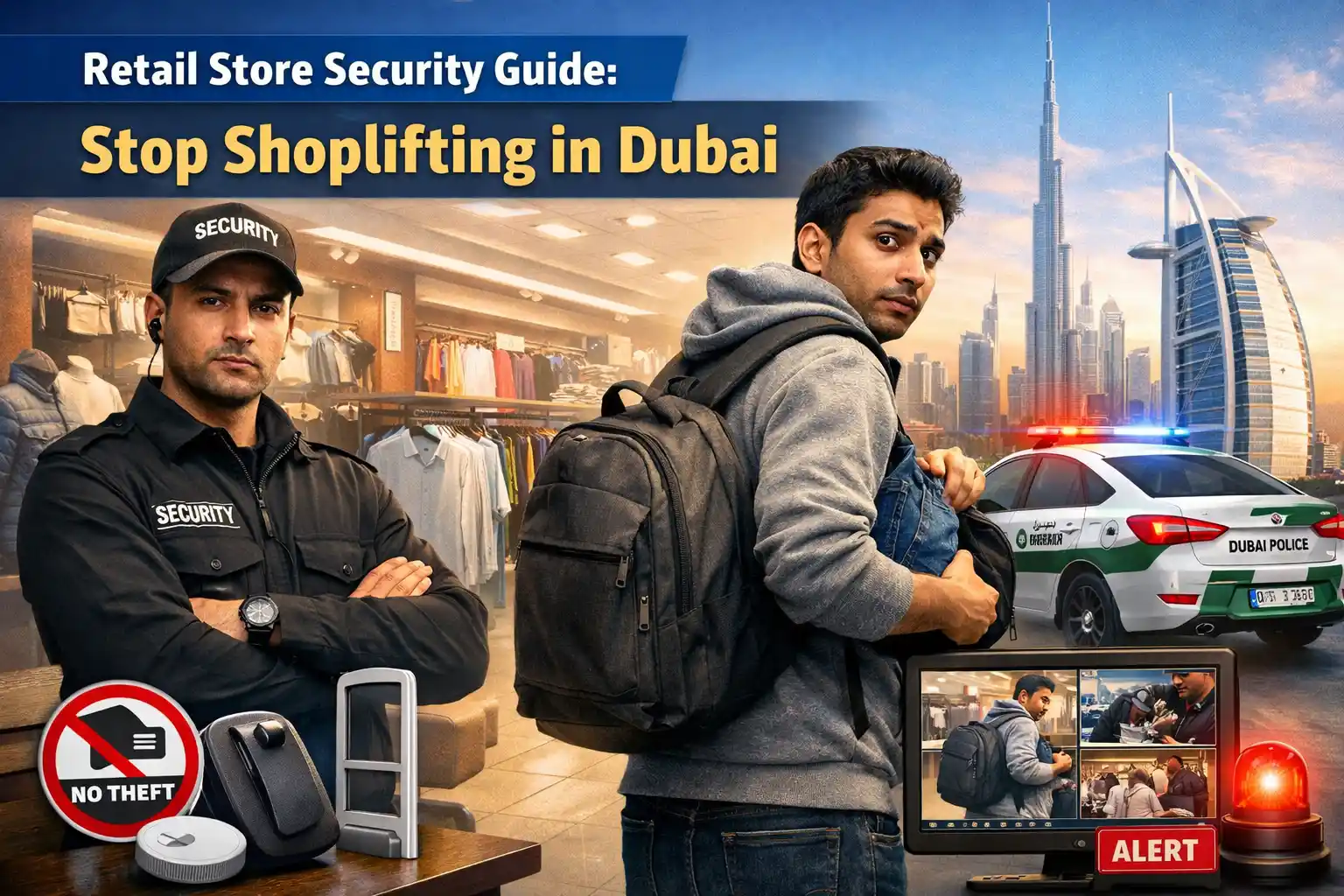
Retail Store Security Guide: Stop Shoplifting in Dubai
April 20, 2026 |
By Junaid Farooq
Summary
Dubai retail owners: this retail store security guide covers CCTV placement, alarm systems, and staff training to stop theft. Whether you manage a boutique in JBR or a supermarket in Deira, shoplifting costs you money every month. A layered security setup cameras, alarms, EAS tags, and access control is the most reliable way to stop it.
Shoplifting is one of the most consistent sources of revenue loss for retail businesses in Dubai. It does not matter whether you run a small fashion outlet in Business Bay or a large pharmacy chain in Deira theft by customers and, in some cases, by staff directly cuts into your margins every single month.
This retail store security guide is written for retail store owners, managers, and loss prevention officers operating in Dubai and the wider UAE. It covers the specific systems, placements, and policies that reduce shoplifting without disrupting the customer experience or creating compliance issues under SIRA regulations.
By the end of this guide, you will know exactly which CCTV cameras to install, where to place them, how alarm systems and electronic article surveillance work together, and what your staff should be doing on the floor every day to prevent theft before it happens.
Why Retail Theft Is a Serious Problem in Dubai
Retail theft in the UAE is more organised than most store owners realise. While opportunistic shoplifting does happen, a growing share of incidents involve organised retail crime (ORC) small groups that target multiple stores in the same mall or district using coordinated methods.
The financial impact is not limited to stolen goods. Inventory shrinkage which includes customer theft, employee theft, vendor fraud, and administrative errors typically accounts for 1.5% to 3% of a retailer’s annual revenue. For a store turning over AED 2 million a year, that is between AED 30,000 and AED 60,000 walking out the door.
Dubai’s high-footfall retail environments shopping malls, tourist strips, open-air markets create conditions where detection is harder. Busy floors, multiple entry and exit points, and large fitting room sections all create opportunities for theft that a basic security setup cannot address.
There is also a compliance angle. Under SIRA (Security Industry Regulatory Agency) guidelines enforced by Dubai Police, many commercial retail premises are required to have an approved CCTV system installed and maintained. Non-compliance can result in fines or difficulties renewing your trade licence.
The good news is that the right combination of systems dramatically reduces incidents. A visible camera setup alone reduces shoplifting attempts most opportunistic thieves will move to a less-monitored store.
CCTV Camera Placement for Retail Stores
Camera placement is where most retail security setups fall short. A store can have ten cameras installed and still have significant blind spots if placement was not planned around actual theft behaviour.
Entry and Exit Points
Every entrance and exit must be covered. These are the highest-priority zones because they capture the clearest footage of everyone entering the store and, critically, anyone attempting to walk out with unpaid merchandise. Mount cameras at a height and angle that captures faces clearly between 2.1 and 2.4 metres is the standard for retail environments.
High-Risk Interior Zones
- Cash counters and POS terminals — essential for monitoring both customer transactions and staff behaviour
- High-value merchandise shelving — jewellery, electronics, premium cosmetics, and designer accessories
- Fitting room corridors — camera must face the entrance only (interior coverage is illegal in the UAE)
- Stockroom door and back office entrance — to monitor staff access to inventory
- Blind corners and aisle ends — areas where customers move out of natural sightlines
Camera Types to Use
Dome cameras are the standard choice for general floor coverage. Their 360-degree range and tamper-resistant housing make them difficult to avoid or disable. PTZ (pan-tilt-zoom) cameras are better for large retail floors where a security officer needs to track movement in real time. Bullet cameras work well at entrances and exit lanes where a fixed directional view is needed.
IP cameras are the right choice for any new installation in Dubai. They deliver higher resolution footage than analogue systems, support remote access through a secure app or web dashboard, and integrate directly with NVR (network video recorder) systems for organised storage and retrieval.
How Many Cameras Does a Small Retail Store Need?
A store floor area of up to 200 square metres typically requires between 6 and 10 cameras depending on layout, fitting room count, and number of entry points. Larger stores need a site assessment to map coverage zones properly. The goal is zero dead zones any area not covered by at least one camera is a theft risk.
Alarm Systems and Intrusion Detection
CCTV records what happens. An alarm system stops it from happening or at minimum, limits the damage when it does.
For retail stores in Dubai, the most relevant alarm applications are after-hours intrusion detection and in-store panic response. After a store closes, motion detectors and door/window contact sensors create a perimeter that triggers an immediate alert if anyone enters without authorisation.
Key Components of a Retail Alarm Setup
- Motion detectors — placed at entry points and near high-value product areas
- Door and window contact sensors — alert when any opening is breached after closing
- Glass break sensors — detects the specific acoustic signature of breaking glass
- Panic buttons at the till — staff can silently alert security without confrontation
- SMS and app alerts — store owner and security officer receive real-time notifications on their phone
The most effective setups integrate the alarm system with the CCTV network. When a sensor is triggered, the connected cameras begin recording immediately and can push a live feed to the monitoring party. This removes the gap between an alert and a visual confirmation of what is happening.
For larger stores or those operating in high-risk zones, a central monitoring station connection means a third-party security team receives alerts and can dispatch a response within minutes even if the store owner is unreachable.
Electronic Article Surveillance (EAS) Systems
Electronic article surveillance is the system behind the security gates you see at the entrance of most clothing, electronics, and cosmetics stores. It is one of the most cost-effective deterrents available for retail environments where individual product tagging is practical.
How EAS Works
Each product is fitted with a hard tag or a soft adhesive label that contains an electronic element. When a tagged item passes through the EM pedestals at the store exit without being deactivated at the POS, the pedestal triggers an audible and visual alarm. Tags are deactivated or removed at the point of sale when a legitimate purchase is made.
Best Applications in Dubai Retail
- Fashion and apparel stores — hard tags on garments are standard and highly visible
- Electronics retail — security cables and soft labels protect high-value items
- Cosmetics and pharmacy — small, concealable items benefit from EAS labels
- Accessories and jewellery — combined with CCTV, EAS creates a double deterrent
EAS systems work best when combined with CCTV at the exit point. The alarm identifies that a tagged item is leaving; the camera captures the individual. Together, they provide both the deterrent and the evidence.
False alarms can be an issue if deactivation at POS is inconsistent. Train your cashiers to deactivate or remove every tag before handing over the purchase. A high false alarm rate desensitises staff and reduces the system’s credibility as a deterrent.
Door Access Control for Staff-Only Areas
A significant portion of retail shrinkage does not come from customer theft it comes from internal theft. Stockrooms, back offices, and receiving areas are the highest-risk zones, and in most stores, access to these areas is poorly controlled.
A door access control system restricts entry to staff-only areas using keycards, PIN codes, or biometric authentication such as fingerprint or facial recognition. Every access attempt is logged with a timestamp, creating a complete audit trail. If stock goes missing, you can identify exactly who accessed the stockroom and when.
Where to Install Access Control in a Retail Store
- Stockroom and inventory storage area
- Back office and cash handling room
- Server or CCTV recording room
- Staff-only corridors in large stores
Fitting Room Management
Fitting rooms are a common location for concealment theft. Physical access control here does not mean electronic locks it means an attendant system where a staff member controls how many items a customer takes in and issues numbered tags accordingly. This reduces concealment significantly and creates accountability without requiring expensive hardware.
Staff Training and Internal Theft Prevention
Technology covers a large part of your security requirement, but staff behaviour determines whether the technology actually works. A camera installed in the wrong position because the manager was not involved in the planning, a panic button that nobody knows exists, or a stockroom door propped open to make loading easier these human factors undo good installations.
What Your Staff Need to Know
- How to use the panic button and what triggers a response
- Where cameras are positioned and what they cover (staff should not feel surveilled, but should understand the system exists)
- What to do when they suspect shoplifting observe and report, never physically detain a suspected thief
- Cash handling protocols at the POS to prevent internal shrinkage
- How to complete receipt and transaction reconciliation at end of shift
Internal theft is harder to detect than customer theft because it often involves small, regular removals rather than a single event. POS transaction monitoring looking for patterns of voids, discounts, or refunds processed by a specific employee is one of the most reliable ways to identify it.
Larger retail operations should consider appointing a dedicated loss prevention officer whose role includes regular stock audits, reviewing CCTV footage, and managing access control logs. In smaller stores, this responsibility sits with the store manager.
Building a Layered Retail Security System in Dubai
None of the systems above works in isolation as well as they work together. A layered approach means that when one layer fails a camera angle is blocked, a tag is removed — another layer catches what was missed.
How the layers work together: CCTV provides deterrence, documentation, and real-time monitoringEAS gates catch items leaving without payment and create an audible alertAlarm systems protect the store after hours and provide panic response during trading hoursAccess control limits internal theft and provides audit logs for investigationStaff protocols ensure the technology is used correctly and consistently
All of these systems can now be integrated into a single platform. An NVR connected to your alarm triggers means cameras start recording the moment a sensor fires. A door access log combined with inventory data lets you cross-reference stockroom access against missing stock dates. Remote monitoring through a secure mobile app means you can check in on your Dubai store from anywhere.
Every system installed in a commercial retail environment in the UAE must comply with SIRA (Security Industry Regulatory Agency) standards set by Dubai Police. This means using approved equipment, maintaining proper installation documentation, and keeping your system in working order. A SIRA-compliant installation protects you legally and ensures your footage is admissible if you need it for a police report or insurance claim.
The time to build this setup is before a significant theft incident, not after. The cost of a professional integrated system is a fraction of what most retailers lose to shrinkage in a single year.
Conclusion
Stopping shoplifting in a Dubai retail environment requires more than a single camera above the door. It requires the right cameras in the right positions, an alarm system that responds in real time, EAS protection on your highest-risk products, controlled access to your back-end areas, and staff who know how to use all of it.
The stores that see the biggest reduction in shrinkage are the ones that treat security as a system, not a box to check. Every layer you add makes the next theft attempt harder.
Need a Retail Security Setup in Dubai? Wiznet installs CCTV systems, alarm systems, and access control solutions for retail stores across Dubai fully compliant with SIRA requirements. We carry out a free site survey, assess your store layout, and recommend the right setup for your space and budget. Call us: +971 522336984 | Website: wiznet.ae/contact-us/
Frequently Asked Questions
What type of CCTV camera is best for a retail store in Dubai?
Dome cameras are the most common choice for general floor coverage. PTZ cameras suit large stores where live tracking is needed. IP cameras are recommended over analogue for all new retail installations because of their higher resolution and remote access capability.
Is CCTV mandatory for retail stores in Dubai?
SIRA regulations require many commercial premises in Dubai to have an approved surveillance system in place. The specific requirement depends on your trade licence category and premises size. A SIRA-certified installer like Wiznet can confirm what applies to your store and ensure your installation is compliant.
What is EAS and do I need it for my store?
Electronic article surveillance (EAS) uses security tags and exit pedestals to detect unpaid items leaving the store. It is most cost-effective for fashion, electronics, and cosmetics retail where individual product tagging is practical. EAS is particularly effective when combined with CCTV at exit points.
How do I prevent internal theft in my retail store?
Internal theft is best addressed through a combination of access control on stockrooms and back offices, POS transaction monitoring, regular stock audits, and clear cash handling protocols. An audit log from your access control system lets you cross-reference who was in the stockroom with when stock went missing.
Can I monitor my Dubai retail store remotely?
Yes. Modern IP CCTV systems and integrated alarm platforms support remote access through a secure mobile app or web dashboard. You can view live feeds, review recorded footage, and receive real-time alerts from anywhere with an internet connection.

Junaid Farooq
A technology specialist with a focus on IT infrastructure and security solutions. Shares expert advice on topics like access control, CCTV, and smart solutions to help businesses across the UAE build smarter, more secure systems.