
Basic Security Systems: How Burglars Beat Them & You Can’t
April 20, 2026 |
By Junaid Farooq
Summary
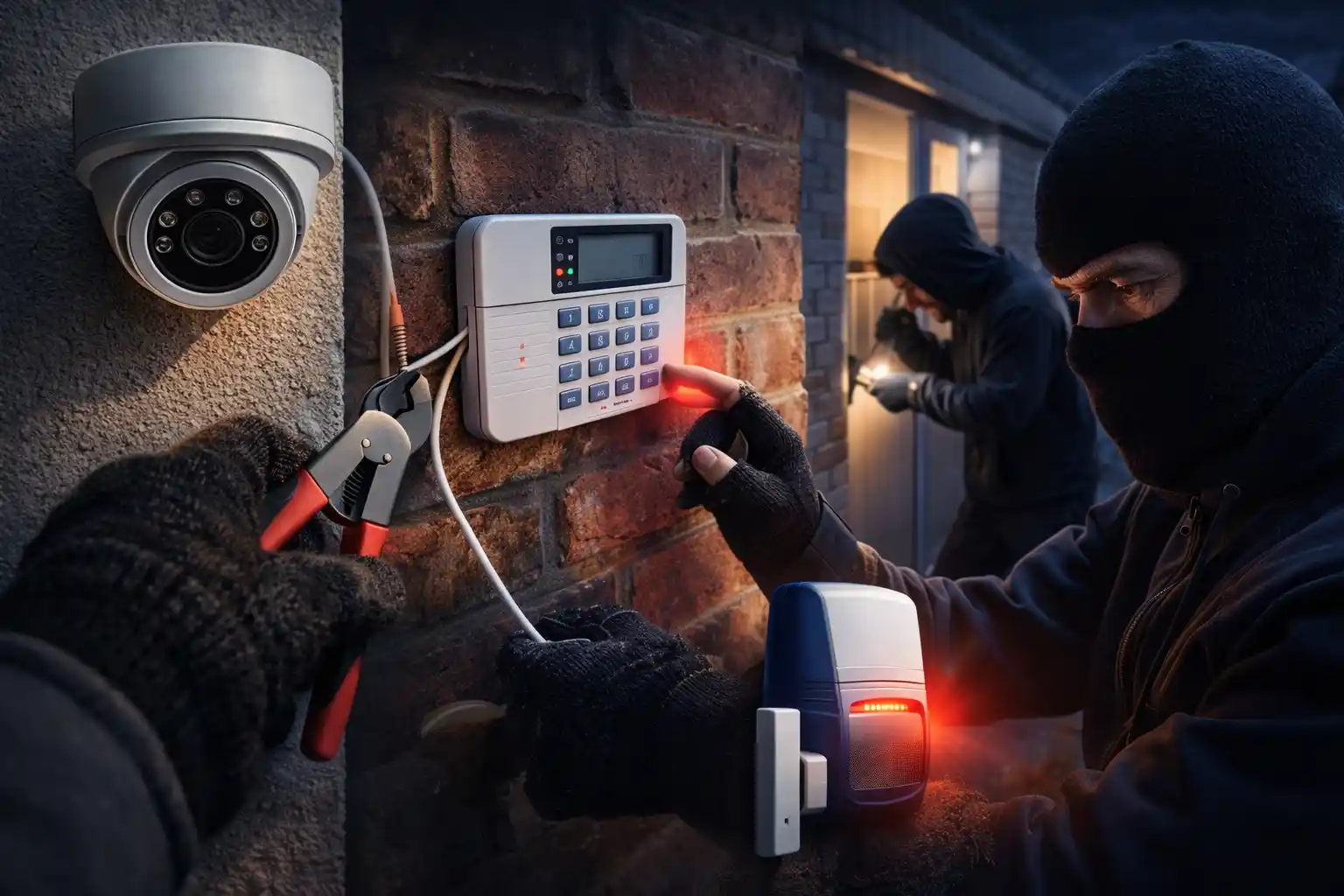
Most homeowners install a basic security system and assume the job is done. Criminals know exactly how to beat these setups and they do it faster than most people expect. This guide covers the real methods used to bypass common systems and the specific upgrades that stop them.
A basic alarm or a couple of CCTV cameras feel reassuring. But security is not about how much equipment you have it is about how well it covers every weak point.
Criminals do not guess. They study. Most break-ins are planned after the target is observed for patterns and gaps.
This post covers exactly how intruders defeat basic security systems and what a properly upgraded setup looks like to stop them.
1. Why Basic Security Systems Fall Short
Basic systems are designed for affordability and ease of installation. Protection depth is not the priority.
Here is what most basic setups rely on and where each one fails:
| What It Does | Where It Fails |
| Single wired alarm siren | Loud noise only no monitoring, no response |
| Standard CCTV camera | Fixed angle, limited resolution, easy to avoid |
| Basic door lock | Pickable, bumpable, or defeated by a kick to the frame |
| Wireless motion sensor | Jammable, limited coverage zone, triggered by false alarms |
| Wi-Fi-only IP camera | Goes offline if internet is cut no backup recording |
The core problem: basic systems are reactive. They respond after a breach starts not before.
2. How Burglars Bypass Basic Security Systems
These are not rare techniques. They are widely known and quick to execute.
2.1 Wireless Signal Jamming
Many wireless alarm systems use radio frequencies to communicate between sensors and the control panel.
- A cheap signal jammer cuts that communication silently
- No signal reaches the monitoring centre the alarm never triggers
- The homeowner sees no alert and finds out after the fact
Fix: Use a wired alarm system or one with dual-path communication (GSM + broadband). If one path is jammed, the other still works.
2.2 CCTV Blind Spots
Fixed cameras only cover what they face. Criminals scout the property first.
- Side passages, back gates, and rooflines are common blind spots
- Low-resolution footage captures movement but not clear identification
- Some cameras have a narrow field of view easy to enter just outside the frame
Fix: Wide-angle IP cameras with overlapping coverage. Every entry point including secondary access areas needs line of sight.
2.3 Motion Sensor Limitations
PIR (passive infrared) sensors detect body heat and movement but only in their set coverage zone.
- Slow, deliberate movement reduces detection accuracy
- Gaps between sensors create safe corridors to move through
- Frequent false alarms (pets, wind, vehicles) cause owners to disable or ignore the system
Fix: Use sensors with adjustable sensitivity and overlapping coverage. Pet-immune sensors reduce false alarms without sacrificing detection.
2.4 Bypassing Standard Door Locks
Standard mechanical deadbolts are often the weakest physical point in a property.
- Lock picking and bump key attacks defeat most consumer-grade locks in under 60 seconds
- Door frames not locks fail first under a kick or shoulder charge
- Basic magnetic door contacts used in alarm systems can be defeated with an external magnet
Fix: Electronic door access control with biometric or card authentication. No key, no picking. Every entry is logged.
2.5 Cutting Power or Internet
Some basic systems have no failsafe when power or internet is disrupted.
- Cutting mains power disables cameras and alarms without battery backup
- Disabling the Wi-Fi router takes Wi-Fi-only cameras completely offline
- No recording, no alert, no evidence
Fix: Battery backup on all core devices. Cellular (4G/LTE) failover so the system keeps communicating even without internet.
2.6 Exploiting Alarm Response Delays
Many basic alarm systems especially unmonitored ones create a window criminals can work within.
- Entry/exit delay timers give 30–60 seconds before the alarm triggers
- Police response to unmonitored alarms in busy areas can take 15–30+ minutes
- Criminals enter, take what they want, and leave well before anyone arrives
Fix: Professional alarm monitoring with an immediate response protocol. When the alarm triggers, a team responds not just a siren.
Bypass Methods vs. Solutions At a Glance
Here is a direct comparison of each weakness and its practical fix:
| Bypass Method | Why It Works on Basic Systems | Solution |
| Signal jamming | Wireless alarms have no backup communication path | Dual-path alarm (GSM + broadband) |
| CCTV blind spots | Fixed cameras with narrow field of view | Wide-angle IP cameras with overlap |
| Motion sensor gaps | Limited zones, false alarm fatigue | Overlapping sensors, pet-immune tech |
| Door lock bypass | Standard locks lack resistance to bumping or picking | Electronic access control system |
| Power/internet cut | No backup power or cellular failover | Battery backup + 4G failover |
| Response delay exploit | No live monitoring, long police wait times | Professional alarm monitoring |
What a Properly Layered Security System Looks Like
A layered approach means no single point of failure. Each layer works on its own and supports the others.
| Layer | What It Covers |
| Layer 1 — Perimeter | Gate barriers, outdoor sensors, smart video doorbells detect threats before they reach the building |
| Layer 2 — Access Control | Electronic door locks with biometric or card access no bypass through picking or bumping |
| Layer 3 — Surveillance | Wide-angle IP cameras with night vision, onsite recording + cloud backup |
| Layer 4 — Alarm System | Hardwired or dual-path intruder alarm with professional monitoring |
| Layer 5 — Backup Systems | Battery backup and 4G failover system stays online even if power or internet is cut |
The goal is not to make intrusion impossible it is to make it difficult enough that the property gets skipped entirely.
Quick Security Audit Check Your Setup Right Now
Run through this checklist. If you cannot answer ‘Yes’ to most of these, your current setup has gaps.
- Camera coverage: Are all entry points, blind spots, and perimeter areas visible on camera?
- Alarm path: Does your alarm use dual-path communication (not just Wi-Fi or GSM alone)?
- Door security: Are your main entry points protected by electronic access control rather than standard locks?
- Power backup: Does your system continue to work if mains power is cut?
- Monitoring: Is your alarm professionally monitored with an active response not just a local siren?
- Deterrence: Are cameras and alarm signage clearly visible to discourage before entry is even attempted?
If you answered ‘No’ to two or more your setup has exploitable gaps that are well known to criminals.
Signs It Is Time to Upgrade Your Security System
Not every property needs a full overhaul. But these are clear signals that a basic setup is no longer enough:
- Your CCTV system is 3+ years old and uses analog cameras
- Your alarm has no monitoring contract it just sounds locally
- Your main doors still use standard mechanical locks
- Your system relies entirely on Wi-Fi with no cellular backup
- You have had an attempted break-in or noticed unfamiliar activity around the property
- Your building has multiple tenants or high foot traffic basic setups were not designed for this
Frequently Asked Questions
Can basic security systems be bypassed easily?
Yes. Wireless signal jamming, camera blind spots, and standard lock vulnerabilities are well-documented techniques that do not require specialist tools. That is why a layered system with no single point of failure is the practical standard for proper protection.
What is signal jamming and does it work on all alarms?
Signal jamming disrupts the radio frequency communication between wireless sensors and the alarm panel. It does not work on hardwired systems or dual-path systems that switch to a backup channel automatically.
Is a CCTV camera enough on its own?
No. A camera records what happens it does not prevent it. Cameras work best as part of a system that includes an alarm, access control, and monitoring. Coverage gaps and low resolution also limit their usefulness as evidence.
What is a layered security system?
A layered security system uses multiple independent protections perimeter detection, access control, surveillance, alarm, and backup power so that even if one layer fails, others continue to protect the property.

Junaid Farooq
A technology specialist with a focus on IT infrastructure and security solutions. Shares expert advice on topics like access control, CCTV, and smart solutions to help businesses across the UAE build smarter, more secure systems.