
Licensed vs Unlicensed CCTV Installers in Dubai: What Is the Difference
June 16, 2026 |
By Junaid Farooq
Summary
“Hiring an unlicensed CCTV installer in Dubai is not just a quality risk. It is a legal one that can void your insurance and expose you to government fines.”
Dubai has thousands of CCTV installation companies. A quick Google search or a walk through any market in Deira or Al Quoz will show you dozens of options at very different price points. Some charge AED 150 per camera. Others charge AED 600. The work looks similar on the surface. The difference is not always visible in the quote.
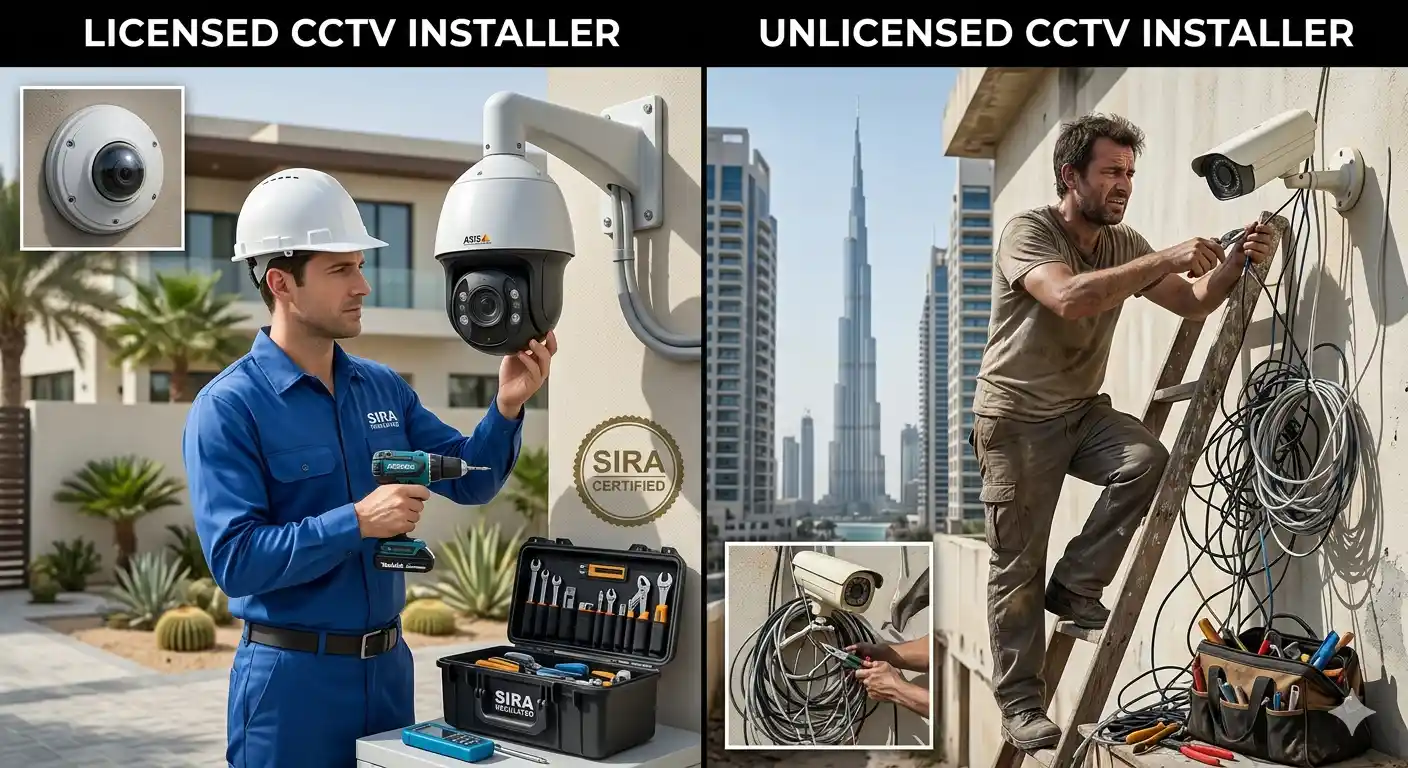
The real difference is licensing. Specifically, whether the company holds a valid SIRA license or not. That single factor determines whether your CCTV system is legally compliant, whether your footage will hold up in a dispute, and whether your insurance policy remains valid after installation.
What Is SIRA and Who Does It Apply To
SIRA stands for Security Industry Regulatory Agency. It operates under the General Directorate of Residency and Foreigners Affairs in Dubai. Its mandate is to regulate all private security-related activities in the emirate, including the installation of electronic security systems such as CCTV, access control, and intruder alarm systems.
Any company that installs, maintains, or supplies CCTV systems in Dubai must hold a valid SIRA license. This is not optional. It applies to individual technicians, small firms, and large security companies equally.
There are also specific license categories under SIRA. A company installing basic analogue CCTV is classified differently from one installing advanced IP network systems or integrated video analytics platforms. The license a company holds must match the work they carry out.
| Key Entity | SIRA | Security Industry Regulatory Agency, Dubai | Regulates all private security installation work |
What Licensed CCTV Installers Must Meet
Getting a SIRA license is not a simple registration process. There are specific requirements that companies and their engineers must fulfil before approval is granted. These requirements exist to protect property owners and ensure work meets a minimum quality and safety standard.
Here is what a licensed CCTV installer in Dubai must have in place:
- Qualified engineers: Technicians must hold recognised security system certifications such as those from the Security Systems Association (SSA) or equivalent bodies approved by SIRA.
- Approved equipment: Licensed companies are required to use CCTV hardware that meets UAE technical standards. Generic or counterfeit cameras that lack proper certification do not qualify.
- Professional indemnity insurance: Companies must carry valid insurance that covers damage, errors, or liability arising from their installation work.
- Trade licence with security category: The company must hold a valid Dubai trade licence that specifically includes security system installation as a permitted activity.
- Renewal compliance: SIRA licenses are not permanent. They require renewal and companies must demonstrate continued compliance to maintain their status.
- Adherence to Dubai Municipality and TRA regulations: Work must comply with relevant building and telecommunications regulations, not just SIRA rules alone.
When a licensed company completes an installation, they can provide documentation confirming compliance. That paper trail matters for insurance claims, building handovers, and any future legal disputes involving the footage.
What the License Process Covers
| Requirement | What It Means for You | Without It |
| Engineer certification | Trained technician handles your system | Untrained labour, higher error risk |
| Approved camera brands | Hardware meets UAE quality standards | No quality guarantee on equipment |
| Professional indemnity | You are covered if work causes damage | You absorb full liability |
| Compliance documentation | Paper trail for insurance and audits | No record, no proof of compliance |
The Real Risks of Using an Unlicensed CCTV Installer
The biggest mistake buyers make in Dubai is assuming that if the cameras work and the picture is clear, the job is done. That thinking misses the point entirely. A fully functional CCTV system installed by an unlicensed company still carries serious risks that only appear later, often at the worst possible moment.
| Risk Area | What Happens | Consequence |
| Footage inadmissibility | Dubai courts can reject CCTV evidence from non-compliant installations | You lose your only evidence in a theft, assault, or dispute |
| Insurance void | Many insurers require licensed installation as a condition of security-related coverage | Your claim gets rejected when you need it most |
| Government fines | SIRA and Dubai Municipality inspections can flag unlicensed work on commercial properties | Fines and mandatory removal at owner’s expense |
| No warranty protection | Camera brand warranties are often voided if installation was done by an uncertified party | You pay for repairs out of pocket |
| Liability shift | If the installation causes electrical damage or a fire, liability falls on the property owner | You bear full legal and financial exposure |
| No compliance documentation | Landlords and developers may reject building handovers with unlicensed security installations | Delays in handover, additional costs to redo the work |
The pattern across all of these risks is the same. The problem does not appear on installation day. It appears when you need the system to actually protect you. That is the worst time to discover that the installer was not licensed.

How to Verify a SIRA License Before You Hire
Verifying a SIRA license takes less than five minutes. It is one of the most important steps you can take before signing any agreement with a CCTV installation company in Dubai. Here is how to do it:
- Ask the company for their SIRA license number and a copy of the license certificate.
- Visit the SIRA official website or use the GDRFA Dubai digital services portal to check the license status.
- Confirm the license category matches the type of work being carried out, such as electronic security system installation.
- Check the expiry date. A license that expired six months ago offers no protection.
- Verify the company’s trade licence through the Dubai Department of Economic Development (DED) portal to confirm security installation is listed as a permitted activity.
| Quick Check | A reputable CCTV company in Dubai will provide their SIRA license number without hesitation. If a company hesitates, avoids the question, or cannot produce documentation within 24 hours, treat that as a serious red flag. |
Cost Comparison: Licensed vs Unlicensed Installers in Dubai
The price gap between a licensed and an unlicensed CCTV installer in Dubai is real. Licensed companies carry overheads that unlicensed ones do not. These include engineer salaries, certification renewals, insurance premiums, and compliance documentation. Those costs are reflected in their quotes.
However, the cost comparison only makes sense when you account for the full picture:
| Cost Factor | Licensed Installer | Unlicensed Installer |
| Installation cost (4 cameras) | AED 1,800 to 2,800 | AED 800 to 1,400 |
| Camera brand quality | Hikvision, Dahua, Axis (certified) | Generic, unbranded (common) |
| Manufacturer warranty | Valid (1 to 3 years) | Often voided by uncertified install |
| Compliance documentation | Provided | Not available |
| Insurance compatibility | Accepted by UAE insurers | May void security clauses |
| Cost of non-compliance (if caught) | None | AED 5,000+ fines, removal costs |
| Footage legally usable | Yes | Not guaranteed |
The upfront saving with an unlicensed installer can be AED 1,000 to 1,500 on a small job. A single insurance rejection or government fine wipes out that saving entirely, often many times over. For commercial properties where compliance audits are routine, the risk calculus is even clearer.
What Happens During a Government or Insurance Inspection
Property inspections in Dubai are more common than many owners expect. Municipality inspectors, civil defence officers, and insurance assessors all have the authority to review security installations on commercial and residential properties.
When an inspector reviews a CCTV system, they are looking for three things:
- Proof that the installation company holds a valid SIRA license for the work carried out.
- Confirmation that the equipment used meets UAE technical standards and is not counterfeit or uncertified.
- A compliance certificate or installation report from the security company.
An unlicensed installation fails on all three counts. The property owner is then responsible for bringing the system into compliance, which typically means ripping out the existing installation and starting again with a licensed company. That doubles the total cost and adds delays to any ongoing building or business operation.
For businesses in regulated sectors such as hospitality, retail, healthcare, and financial services, CCTV compliance is not just about the cameras. It connects to broader operating licence conditions. A failed CCTV audit can trigger a wider review of all safety and security measures on the premises.
Licensed vs Unlicensed: Side-by-Side Summary
| What You Get | Licensed Company | Unlicensed Company |
| SIRA-compliant installation | Yes | No |
| Certified engineers on site | Yes | Not guaranteed |
| Insurance-valid documentation | Yes | No |
| Footage accepted by Dubai courts | Yes | Not guaranteed |
| Manufacturer warranty valid | Yes | Often voided |
| Passes Dubai compliance audit | Yes | Fails |
| After-sales maintenance contract | Standard offering | Rarely available |
Conclusion
The licensing gap between CCTV companies in Dubai is not a technicality. It is a practical divide that affects whether your system protects you in a real situation. A licensed installer gives you compliant footage, valid warranties, working insurance, and documentation that stands up to scrutiny. An unlicensed one gives you cameras that may look identical but carry risks that only surface when something goes wrong.
Checking SIRA licensing before you hire takes five minutes. Not checking it can cost you far more than the installation itself. Wiznet is a SIRA-licensed CCTV installation company serving residential and commercial properties across Dubai. If you want a free site survey and a written compliance quote, contact the team before you book any installer.
FAQs
Is SIRA licensing mandatory for all CCTV installations in Dubai?
Yes. Any company providing CCTV installation services in Dubai must hold a valid SIRA license. This applies to both residential and commercial properties. There are no exemptions for small jobs or budget installations.
Can I install my own CCTV system at home without a licensed company?
For purely internal use in your own home, some plug-and-play systems fall outside SIRA’s commercial installation mandate. However, any permanent wired installation should be handled by a licensed company to protect your insurance and ensure compliance with building regulations.
What happens if I already have CCTV installed by an unlicensed company?
You should get a compliance review from a licensed CCTV company as soon as possible. Depending on the quality of the existing installation, it may need to be partially or fully redone. Some licensed companies will audit existing systems and issue documentation if the hardware and cabling meet required standards.
How do I know if a CCTV company in Dubai is really SIRA licensed?
Ask for their SIRA license number and verify it on the GDRFA Dubai portal. Also check that their Dubai trade licence through the DED includes security system installation as an approved business activity. A certificate alone is not enough if the company cannot be found on the official registry.

Junaid Farooq
A technology specialist with a focus on IT infrastructure and security solutions. Shares expert advice on topics like access control, CCTV, and smart solutions to help businesses across the UAE build smarter, more secure systems.
