
Warehouse Security Checklist for UAE Businesses
July 17, 2026 |
By Junaid Farooq
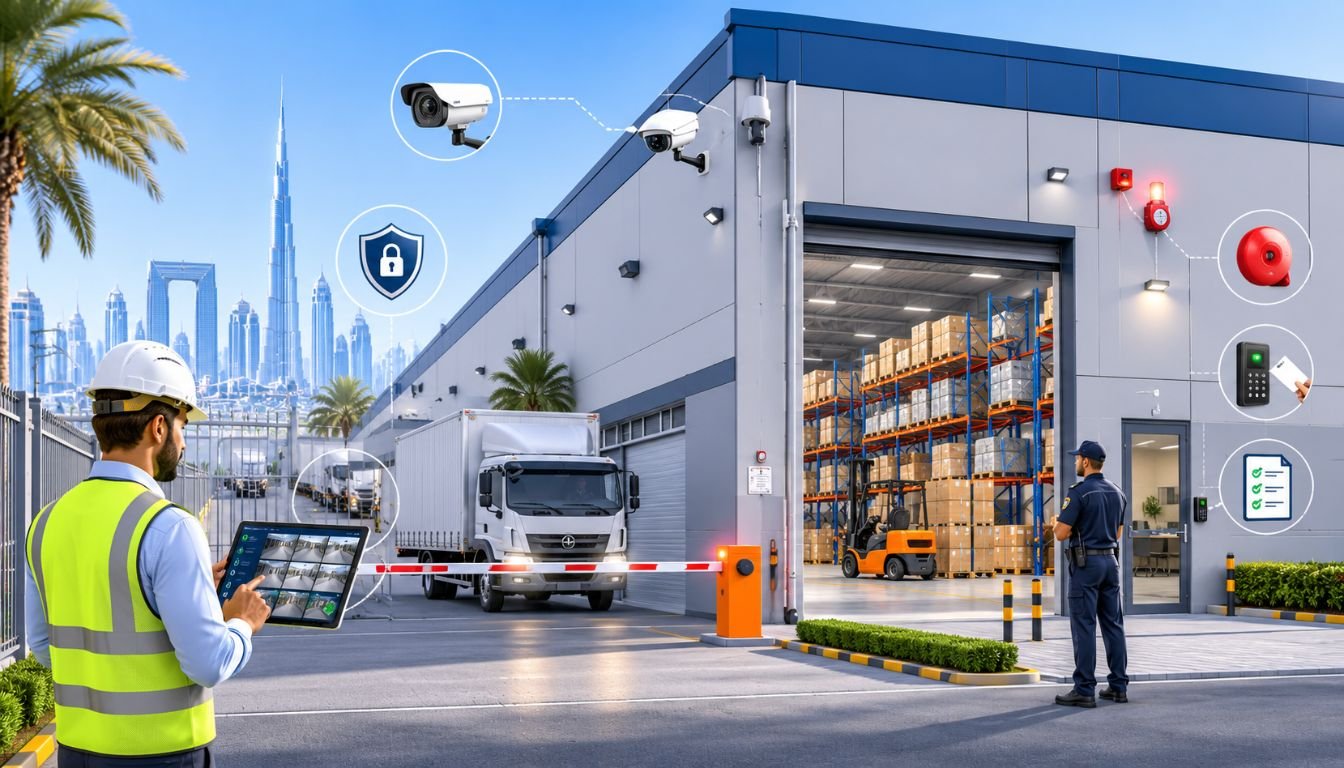
Warehouses are the backbone of many businesses across the UAE. Whether you store retail products, construction materials, food supplies, electronics, or industrial equipment, your warehouse contains valuable assets that require reliable protection. A single security incident can lead to financial loss, operational disruption, damaged customer trust, and higher insurance costs.
Unlike offices or retail shops, warehouses present unique security challenges. Large floor areas, multiple entry points, loading docks, vehicle movement, and limited staffing after business hours create opportunities for theft and unauthorized access. Because of these factors, warehouse security should never rely on a single solution. Instead, businesses should combine CCTV surveillance, access control, alarm systems, vehicle management, and fire protection into one integrated security strategy.
This comprehensive warehouse security checklist explains the essential measures every UAE business should consider to protect employees, inventory, and operations while staying prepared for future growth.
Why Warehouse Security Is More Important Than Ever
Modern warehouses are more than storage facilities. They function as distribution hubs where inventory is constantly moving between suppliers, employees, transport companies, and customers.
Every day, numerous people may enter and leave the premises, including:
- Warehouse staff
- Delivery drivers
- Contractors
- Maintenance teams
- Visitors
- Logistics partners
Without proper monitoring, it becomes difficult to know who accessed specific areas or when goods were moved.
For businesses operating in Dubai and across the UAE, investing in professional security infrastructure helps reduce risks while improving operational accountability.
Some of the biggest benefits include:
- Protection against theft and vandalism
- Better employee safety
- Improved inventory monitoring
- Faster incident investigations
- Greater operational control
- Compliance with commercial security requirements
Common Security Risks in UAE Warehouses
Every warehouse faces different challenges depending on its size and operations. However, most security incidents fall into several common categories.
After-Hours Break-Ins
Criminals often target warehouses during evenings, weekends, or holidays when fewer employees are present. Large facilities located in industrial zones can become especially vulnerable if perimeter security is weak.
High-value products such as electronics, tools, pharmaceuticals, and automotive parts are frequent targets.
Internal Theft
Not every inventory loss comes from external intruders.
Sometimes products disappear gradually due to unauthorized employee access, improper supervision, or weak inventory controls.
Without CCTV footage and access records, identifying when and how inventory disappeared becomes extremely difficult.
Loading Dock Vulnerabilities
Loading docks experience constant activity throughout the day.
Vehicles arrive regularly, goods are transferred quickly, and employees focus on logistics rather than security.
This creates opportunities for:
- Unauthorized product removal
- Vehicle theft
- Package tampering
- Unrecorded deliveries
- Unauthorized visitors entering restricted areas
Proper surveillance around loading zones helps reduce these risks significantly.
Unauthorized Access
Warehouses usually have several entrances, including:
- Main entrances
- Staff doors
- Emergency exits
- Vehicle gates
- Loading bays
If these access points remain unsecured, unauthorized individuals can enter sensitive areas without being detected.
Installing a modern door access control system helps businesses manage exactly who enters each part of the facility while maintaining complete access records.
CCTV Coverage Checklist for Warehouses
A professionally designed CCTV system forms the foundation of warehouse security.
Rather than placing cameras randomly, each area should be covered according to its level of risk and daily activity.
Professional CCTV camera installation ensures that blind spots are minimized while providing clear video evidence whenever incidents occur.
Monitor the Entire Perimeter
The outside of your warehouse should always be monitored before someone reaches the building.
Install cameras that cover:
- Boundary walls
- Perimeter fencing
- Parking areas
- Entry gates
- Side pathways
- Emergency exits
Outdoor cameras should be weather-resistant and capable of producing clear footage during both daytime and nighttime conditions.
Secure Loading Docks
Loading docks deserve special attention because they experience continuous movement throughout the day.
Install cameras that capture:
- Delivery vehicles
- Vehicle registration numbers
- Goods entering the warehouse
- Goods leaving the warehouse
- Staff handling shipments
- Visitor activity
High-resolution bullet CCTV cameras are commonly used because they provide excellent long-distance coverage while acting as a visible deterrent.
Monitor Interior Warehouse Floors
Large warehouse interiors often contain high ceilings and wide open spaces.
Instead of installing dozens of fixed cameras, businesses can combine them with PTZ (Pan-Tilt-Zoom) cameras.
PTZ cameras allow operators to:
- Rotate across wide areas
- Zoom into suspicious activity
- Monitor multiple aisles
- Track moving individuals remotely
This makes them ideal for warehouses with extensive storage areas.
Watch High-Value Inventory Areas
Certain parts of the warehouse require additional monitoring.
Dedicated cameras should cover:
- High-value inventory
- Packing stations
- Dispatch counters
- Receiving areas
- Inventory inspection zones
- Product return sections
These locations often experience the highest volume of product handling and therefore present greater opportunities for inventory discrepancies.
Access Control for Warehouse Security
While CCTV records events, access control systems determine who can enter the building in the first place.
Together, these technologies provide a much stronger security solution than either system alone.
Restrict Employee Access
Not every employee requires access to every part of the warehouse.
Access permissions can be assigned based on:
- Department
- Job role
- Shift timing
- Management approval
Using card readers, PIN codes, or biometric authentication ensures employees only enter areas necessary for their work.
Modern biometric access control systems also create accurate logs showing:
- Who entered
- Which door was used
- Date and time of access
- Duration of entry
These records become invaluable during security investigations or inventory audits.
Control Visitor and Contractor Access
Warehouses regularly receive third-party visitors, including suppliers, delivery personnel, maintenance contractors, and inspectors.
Instead of allowing unrestricted movement, businesses should:
- Register all visitors
- Issue temporary access credentials
- Escort contractors when required
- Restrict access to designated areas
- Record entry and exit times
A structured visitor management process reduces unnecessary risks while improving accountability.
Gate Barrier Systems for Better Vehicle Security
Managing vehicle movement is just as important as controlling pedestrian access. Every truck, delivery van, contractor vehicle, or visitor entering your warehouse should pass through a controlled entry point.
A gate barrier system allows businesses to regulate vehicle access while maintaining a record of every entry and exit. When integrated with CCTV cameras, the system creates a complete audit trail that helps improve security and operational efficiency.
Secure Your Vehicle Entry Points
An automated gate barrier can help you:
- Prevent unauthorized vehicles from entering the premises
- Manage scheduled deliveries more efficiently
- Reduce tailgating at entrances
- Record vehicle movement throughout the day
- Improve overall site safety
For larger warehouses, gate barriers can also be integrated with RFID cards, access control systems, ANPR (Automatic Number Plate Recognition), or security personnel to streamline vehicle management.
Install an Intruder Alarm System for After-Hours Protection
Even the best CCTV cameras cannot actively stop a break-in. They record events, but an intruder alarm system immediately alerts property owners or security personnel when unauthorized access is detected.
Since many warehouses operate with minimal or no staff overnight, alarm systems provide an essential layer of protection outside normal business hours.
Areas That Should Be Protected
An alarm system should cover:
- Main entrances
- Emergency exits
- Loading docks
- Warehouse offices
- Storage rooms
- Windows
- Roof access points
Motion detectors, magnetic door contacts, glass-break sensors, and vibration detectors work together to identify potential intrusions before significant damage occurs.
Benefits of Intruder Alarm Systems
A professionally installed alarm system can:
- Detect break-in attempts immediately
- Reduce response times
- Deter criminal activity
- Minimize inventory losses
- Provide peace of mind outside business hours
Many modern systems can also send instant notifications to designated managers or security teams through mobile apps, ensuring faster action during emergencies.
Integrate Fire Alarm Systems with Your Security Infrastructure
Warehouse security isn’t only about preventing theft it also includes protecting people and property from fire hazards.
Warehouses often store combustible materials, packaging supplies, chemicals, or electrical equipment that can increase fire risks. Integrating your fire alarm system with other security technologies creates a safer and more responsive environment.
A comprehensive fire protection setup may include:
- Smoke detectors
- Heat detectors
- Manual call points
- Audible and visual alarms
- Emergency evacuation notifications
- Central monitoring systems
When connected with CCTV and access control systems, emergency responders can quickly identify affected areas and coordinate evacuations more effectively.
Consider SIRA Compliance for Commercial Warehouses
Businesses operating in Dubai should understand the requirements established by the Security Industry Regulatory Agency (SIRA).
Depending on the facility type and business activity, warehouses may need to follow specific standards relating to CCTV installation, camera positioning, recording quality, and video retention periods.
Planning a security system with compliance in mind helps avoid costly modifications later while ensuring your business meets applicable regulatory expectations.
Working with an experienced security provider can make it easier to design a solution that aligns with your operational needs and local requirements.
Warehouse Security Checklist
| Security Area | Recommended Solution | Priority |
| Exterior perimeter | Weatherproof CCTV cameras | Essential |
| Loading docks | Bullet cameras with clear dock coverage | Essential |
| Interior warehouse | PTZ cameras for wide-area monitoring | Essential |
| High-value inventory | Fixed CCTV cameras | Recommended |
| Staff entrances | Door access control system | Essential |
| Visitor management | Visitor registration and restricted access | Recommended |
| Vehicle entrances | Automated gate barrier system | Essential |
| After-hours protection | Intruder alarm system | Essential |
| Fire protection | Fire alarm system integration | Essential |
| Compliance | SIRA-aware CCTV planning | Essential |
Best Practices for Warehouse Security
Technology is most effective when combined with clear security procedures.
Warehouse managers should also:
- Inspect cameras regularly to ensure they function correctly.
- Review CCTV footage whenever incidents occur.
- Test alarm systems according to the manufacturer’s recommendations.
- Update employee access permissions when staff roles change.
- Conduct regular security audits to identify vulnerabilities.
- Train employees to report suspicious activity immediately.
- Keep security software and firmware up to date.
- Schedule routine maintenance for all security equipment.
A proactive approach helps prevent incidents before they affect your business.
Secure Your Warehouse with Wiznet
Effective warehouse security requires more than a few cameras. The most reliable protection comes from combining CCTV surveillance, access control, gate barriers, intruder alarms, and fire safety systems into one integrated solution.
At Wiznet, we design and install tailored security systems for warehouses, logistics centers, factories, and commercial facilities across Dubai and the UAE. Our team evaluates your property’s layout, identifies potential security risks, and recommends solutions that provide reliable protection while supporting your day-to-day operations.
Whether you’re securing a new warehouse or upgrading an existing facility, we’re here to help you build a safer, smarter, and more secure environment.
Frequently Asked Questions
How many CCTV cameras does a warehouse need?
The number depends on the warehouse size, layout, and operational requirements. Most facilities use a combination of perimeter cameras, loading dock cameras, PTZ cameras for large interiors, and fixed cameras for high-value storage areas.
Which CCTV camera is best for warehouse security?
There is no single camera suitable for every location. Bullet cameras are ideal for outdoor areas and loading docks, while PTZ cameras provide flexible monitoring inside large warehouse spaces. Fixed dome cameras are commonly installed in offices, corridors, and inventory handling areas.
Why is access control important in warehouses?
Access control limits entry to authorized personnel, records employee movements, and helps protect sensitive inventory from unauthorized access.
Can CCTV work together with alarm systems?
Yes. Integrating CCTV with intruder alarms allows businesses to receive instant alerts while simultaneously viewing live or recorded footage to verify incidents.
Are gate barriers necessary for warehouses?
If your warehouse receives regular deliveries or manages company vehicles, gate barriers provide better control over vehicle access and improve overall site security.
Do warehouses in Dubai need SIRA-compliant CCTV systems?
Many commercial properties are expected to follow SIRA guidelines for CCTV installation and recording. It’s advisable to confirm the specific requirements for your facility before installing or upgrading a security system.

Junaid Farooq
A technology specialist with a focus on IT infrastructure and security solutions. Shares expert advice on topics like access control, CCTV, and smart solutions to help businesses across the UAE build smarter, more secure systems.
