
IP Camera vs Analog Camera: Difference, Cost, and Best Use
July 6, 2026 |
By Junaid Farooq
Summary
“IP and analog cameras serve different security needs and budgets. Learn the real differences in cost, resolution, and setup before you invest in a CCTV system.”
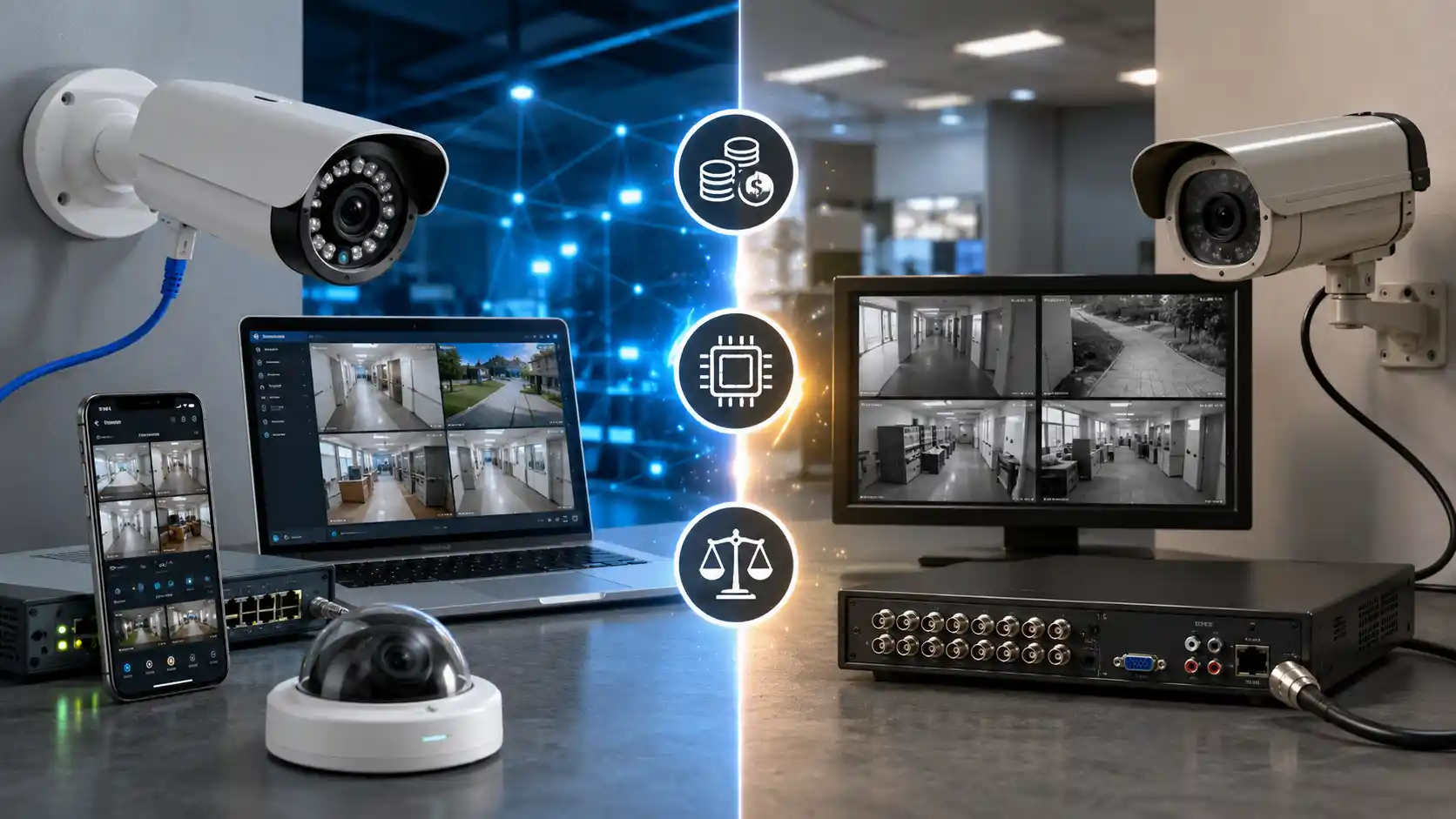
Choosing a CCTV system usually comes down to one decision: IP camera or analog camera. Both record video, but they differ in how they capture, transmit, and store it, as well as in their installation costs. Analog systems are cheaper and simpler. IP systems cost more upfront but deliver sharper footage, remote access, and smarter features. This guide compares the two systems in detail so you can choose the right one for your home, shop, or business in Dubai.
What Is an Analog Camera?
An analog camera captures video and sends it through a coaxial cable to a Digital Video Recorder (DVR), which converts the signal into digital footage for storage and playback. Most modern analog cameras use HD-TVI, HD-CVI, or AHD formats, which support resolutions up to 5MP or 8MP depending on the equipment. Analog systems are a closed setup: cameras connect directly to the DVR, and the DVR handles recording, storage, and local viewing. Power is usually supplied through a separate cable, unless a combined power-video cable is used.
What Is an IP Camera?
An IP (Internet Protocol) camera captures video and converts it into digital data on the camera itself, then sends it over a network using Ethernet cable or Wi-Fi to a Network Video Recorder (NVR) or cloud storage. Most IP cameras use Power over Ethernet (PoE), which carries both power and data through a single cable, reducing wiring work. IP cameras offer resolutions from 2MP up to 4K and beyond. Because footage is already digital, IP systems support features like motion-zone alerts, facial and vehicle detection, and full remote viewing through a mobile app or web browser.
IP Camera vs Analog Camera: Key Differences
The table below summarizes the core technical and practical differences between the two systems.
| Feature | Analog Camera | IP Camera |
|---|---|---|
| Video Quality | Up to 5MP–8MP (format-dependent) | 2MP to 4K and higher |
| Cabling | Coaxial cable | Ethernet (Cat5e/Cat6) or Wi-Fi |
| Power Supply | Separate power cable | PoE (single cable for power and data) |
| Recorder | DVR | NVR |
| Storage | Local DVR hard drive | Local NVR or cloud storage |
| Remote Viewing | Basic, limited app support | Full mobile and web app access |
| Installation Cost | Lower upfront | Higher upfront |
| Cabling Distance | Up to ~300 metres (coax) | Up to ~100 metres (Ethernet), extendable with network switches |
| Video Analytics | Minimal or none | Motion zones, AI-based detection, facial recognition |
| Scalability | Limited by DVR channel count | Easily scalable across a network |
| Cybersecurity Risk | Lower, closed system | Higher, needs network security measures |
| Bandwidth Usage | None, uses analog signal | Uses network bandwidth |
Analog systems win on simplicity and cost. IP systems win on quality, flexibility, and features. The right choice depends on what the property needs.
Cost Comparison: IP Camera vs Analog Camera
Cost is often the deciding factor. Here is a general cost breakdown for a typical 4–8 camera setup in the UAE (actual pricing varies by brand, resolution, and site conditions).
| Cost Component | Analog System | IP System |
|---|---|---|
| Camera Unit (per camera) | AED 150–400 | AED 300–900 |
| Recorder (DVR/NVR) | AED 400–800 | AED 600–1,500 |
| Cabling (per camera run) | AED 50–100 (coax) | AED 80–150 (Cat6) |
| Installation Labor | Lower | Moderate to higher |
| Storage Expansion | Cheaper (local HDD) | Can include cloud subscription |
Analog systems are typically 20–35% cheaper for small installations of 4 to 6 cameras. IP systems cost more initially but need less cabling infrastructure for larger sites, since a single network switch can support many cameras over longer distances than coax alone. For big villas, warehouses, or multi-floor offices, IP systems often become more cost-effective over time due to easier scaling and lower maintenance. Wiznet provides a free site survey to give an accurate, property-specific quote for either system.
Image Quality and Performance
IP cameras generally produce sharper, more detailed footage because resolution isn’t capped by the transmission format. This matters for identifying faces, license plates, or fine detail in large open areas. Analog cameras using HD-TVI or HD-CVI formats have improved significantly and now handle most everyday monitoring well, but they still trail IP cameras in maximum resolution and dynamic range.
Other performance factors to consider:
- Night vision: Both types offer infrared night vision, but higher-end IP cameras often include better low-light sensors.
- Frame rate: IP cameras typically maintain smoother frame rates at high resolution due to better processing.
- Wide Dynamic Range (WDR): More common in IP cameras, useful for areas with strong backlighting, like entrances facing sunlight.
- Storage load: Higher resolution footage from IP cameras requires more storage space or bandwidth, so storage planning matters more with IP setups.
Installation and Cabling Requirements
Analog cameras are easier to retrofit into buildings that already have coaxial wiring, since the existing infrastructure can often be reused. This makes analog a practical choice for older properties or quick upgrades without rewiring.
IP cameras need structured Ethernet cabling or a stable Wi-Fi network. This requires more planning during installation but results in a more future-proof system, since network infrastructure supports higher resolutions and more devices without rewiring later. For properties with existing coax wiring that still want better image quality, HD-TVI or HD-CVI analog upgrades can serve as a middle-ground solution before a full IP migration.
Storage and Bandwidth Planning
Storage needs differ significantly between the two systems, and planning ahead avoids running out of recording space at the wrong time.
- Analog systems record directly to a DVR hard drive. Storage duration depends on resolution, number of channels, and hard drive size, but a typical 2TB drive holds around 15–20 days of continuous footage for a 4-camera, 5MP setup.
- IP systems can record to a local NVR hard drive or to cloud storage. Higher resolution footage consumes more space, so a 4K IP camera can use 3–4 times the storage of a comparable analog camera. Many installers use motion-triggered recording instead of continuous recording to reduce storage load.
- Bandwidth only matters for IP systems. On large sites with many high-resolution cameras, network switches and cabling need to support the combined data load, or footage may lag or drop frames during remote viewing.
Maintenance and Cybersecurity Considerations
Analog systems are a closed loop: cameras connect directly to the DVR with no network exposure, which keeps the cybersecurity risk low. Maintenance is usually limited to cleaning lenses, checking cable connections, and replacing the hard drive when it reaches its lifespan.
IP systems connect to a network, which introduces additional considerations:
- Default passwords on cameras and NVRs should always be changed during setup.
- Firmware should be updated periodically to patch security vulnerabilities.
- Cameras exposed to the internet for remote viewing should sit behind a secured router or VPN rather than being directly port-forwarded.
- Network segmentation (keeping CCTV traffic on a separate network from office computers) reduces risk if a camera is compromised.
These steps are not difficult, but they do require more attention than an analog setup. Businesses without dedicated IT support often prefer working with an installer who can configure these settings correctly from day one.
Best Use Cases
Analog cameras are best for:
- Small retail shops and kiosks
- Budget-conscious homeowners
- Simple perimeter or entrance monitoring
- Buildings with existing coaxial wiring
- Sites where basic recording is enough, without remote analytics
IP cameras are best for:
- Large villas, compounds, and multi-floor offices
- Warehouses and industrial sites needing wide coverage
- Businesses needing remote access from multiple locations
- Properties requiring AI-based analytics, facial recognition, or vehicle tracking
- New builds where structured cabling can be planned from the start
In Dubai, commercial properties must also meet SIRA (Security Industry Regulatory Agency) requirements for CCTV systems. Many SIRA-approved configurations favor IP-based systems for their higher resolution and audit-ready remote access, though approved analog setups are also used depending on the property type. Confirming SIRA compliance during installation avoids issues during licensing or renewal.
Which Should You Choose? A Quick Decision Guide
| If your priority is… | Recommended System |
|---|---|
| Lowest upfront cost | Analog |
| Highest image quality | IP |
| Existing coax wiring | Analog (or HD-TVI upgrade) |
| Remote monitoring via app | IP |
| Large-scale or multi-site coverage | IP |
| Simple, low-maintenance setup | Analog |
| AI analytics (facial/vehicle recognition) | IP |
| SIRA-compliant commercial installation | IP (case-dependent) |
Final Thoughts
Neither system is universally better; the right choice depends on budget, property size, and how much flexibility you need. Analog suits smaller, cost-sensitive setups, while IP suits properties that need higher resolution, remote access, and room to scale. Wiznet offers a free site survey to assess your property and recommend a SIRA-compliant CCTV setup, whether that’s analog, IP, or a hybrid system, based on your actual security needs and budget.
Frequently Asked Questions
Can I mix IP and analog cameras in one system?
Yes, hybrid DVRs and NVRs exist that support both camera types, which is useful when upgrading a system in stages rather than replacing everything at once.
Which lasts longer, IP or analog cameras?
Both typically last 5–10 years with proper maintenance. Lifespan depends more on build quality and environmental exposure than on whether the camera is IP or analog.
Do IP cameras need internet to work?
No. IP cameras need a local network to communicate with the NVR, but internet access is only required for remote viewing or cloud storage, not for basic recording.
Is analog CCTV still worth buying?
Yes, for budget installations, small properties, or buildings with existing coax wiring, analog remains a practical and reliable option, especially with modern HD-TVI and HD-CVI formats.

Junaid Farooq
A technology specialist with a focus on IT infrastructure and security solutions. Shares expert advice on topics like access control, CCTV, and smart solutions to help businesses across the UAE build smarter, more secure systems.
